
Research

Why study brain signals, and what do their fluctuations reveal? We examine how synchronised neuronal activity is reflected in EEG signals, how excitation and inhibition shape oscillations, and how 1/f structure and long-range temporal correlations inform theories of critical brain dynamics.
Our research draws on complexity theory and the study of self-organisation in neuronal networks. It is organised around critical brain dynamics: the idea that neuronal systems may operate near a phase transition where fluctuations become correlated across multiple time scales. We combine criticality theory and computational modelling to develop analytical tools and explore clinical applications.
Core framework
Critical Brain Dynamics
Criticality is well-established in physics: it describes a system at the transition between ordered and disordered states. Near this critical state, fluctuations can acquire a distinctive temporal structure. Statistical signatures associated with critical dynamics include 1/f behaviour and long-range temporal correlations.
We investigate whether neuronal oscillations recorded with EEG and MEG show these temporal signatures in their amplitude fluctuations, how these signatures relate to cognition and perception, and whether they could serve as biomarkers.
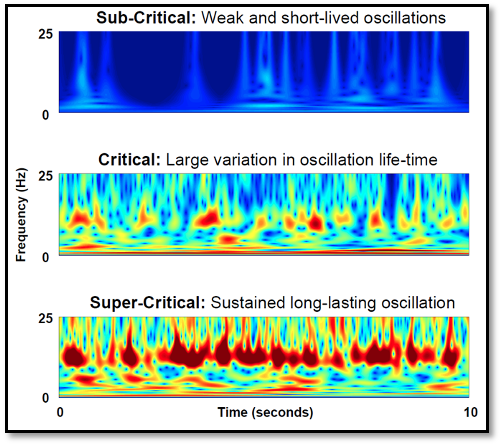
Oscillatory regimes. Sub-critical dynamics show weak, short-lived oscillations. At criticality, oscillation life-times show large variation. Super-critical dynamics produce sustained, long-lasting rhythms.
Source: Avramiea et al., Journal of Neuroscience (2022)
Computational modelling
Excitation-Inhibition Balance
EEG signals reflect the combined electrical activity of large neuronal populations. Excitatory and inhibitory interactions shape how rhythms propagate through these networks and how their amplitude varies over time.
Using the CROS (Critical Oscillations) model introduced by Poil and colleagues (2012), we investigate how the balance between excitation and inhibition can give rise to near-critical dynamics. Connectivity, synaptic strength, and the decay of synaptic currents shape this balance. This gives us a mechanistic link between E/I balance and both the propagation of ongoing rhythms and their temporal structure.
We use this framework to study the functional consequences of near-critical brain dynamics and to develop analytical tools that assess criticality or estimate functional E/I balance from neuronal oscillations in clinically relevant settings.
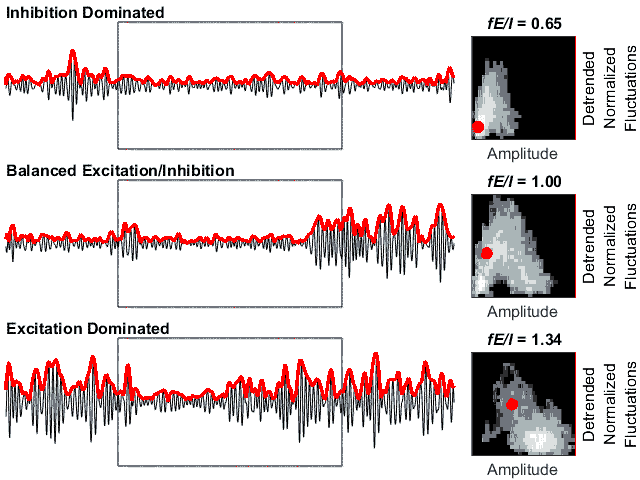
E/I regimes. Oscillation amplitude and temporal structure shift across inhibition-dominated, balanced, and excitation-dominated regimes.
Source: Bruining, Hardstone et al., Scientific Reports (2020)